By Ada Ezeokoli
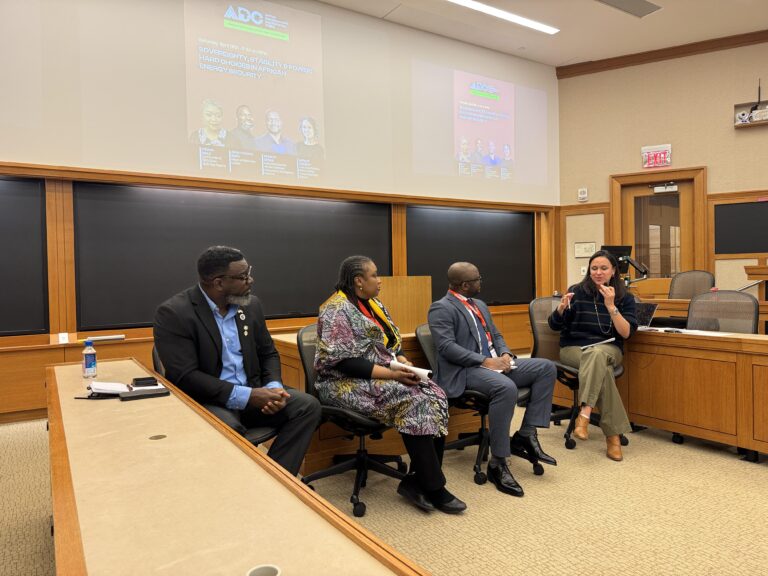
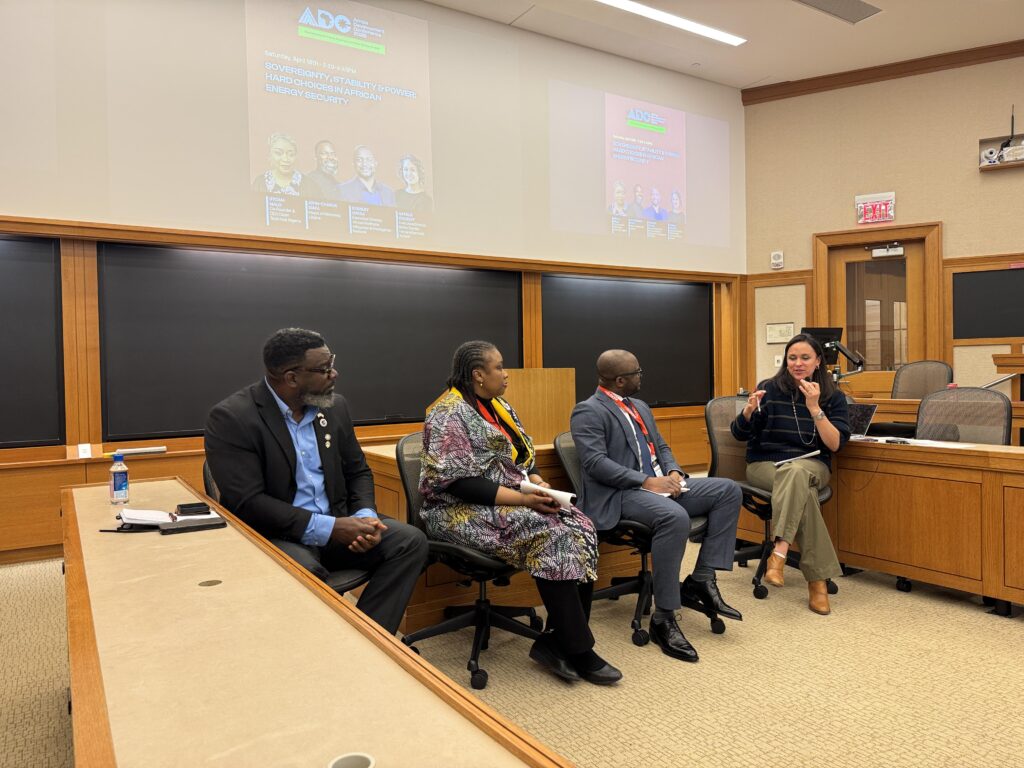
Editor’s Note: This blog is a summary of a panel discussion at the Harvard Africa Development Conference, held in April 2026 and co-organized by the Africa Caucus at Harvard Kennedy School and the Harvard Africa Law Association (HALA) at Harvard Law School. The panel was titled, “Sovereignty, Stability & Power: Hard Choices in African Energy Security.” Panel Speakers were Stanley Opara (African Methane Mitigation and Intelligence Network), Ifeoma Malo (Clean Tech Hub Nigeria), and John-Charuk Siafa (Mayor of Monrovia)
The panel was moderated by Natalie Colbert, Executive Director, The Belfer Center for Science and International Affairs at the Harvard Kennedy School.
The room at Harvard’s Africa Development Conference wasn’t interested in the usual debate. No one was asking whether Africa should choose oil or renewables. The question running underneath everything was far more urgent: How do you give 600 million people electricity when they’ve never had it — while also building an industrial future?
Natalie Colbert, Executive Director of The Belfer Center, set the tone early. The conversation wasn’t about ideology. It was about what actually works.
The Tension Everyone Feels But Few Name
Stanley Opara, Executive Director of the African Methane Mitigation and Intelligence Network, put the paradox plainly. After more than 15 years in the oil and gas industry, he now works on greenhouse gas reduction. He’s seen both sides.
Africa is being asked to do the impossible, he said. The continent needs to secure new energy supplies for the future. But it also has to address the physical challenges it faces today — high energy poverty, infrastructure deficits, and the fact that a significant portion of the population lives without electricity entirely.
“How do we balance exporting energy but also creating domestic capacity?” he asked. “Do we entirely mortgage our future by selling our oil and gas? Or do we keep those resources in the continent and find ways to ensure we’re building capacity for the future?”
It was a question that hung over the entire conversation. And it wasn’t theoretical. It’s playing out right now in boardrooms, ministries, and local governments across the continent.
Where the Rubber Meets the Road
Ifeoma Malo, co-founder of Clean Tech Hub Nigeria, works at the sharpest end of this problem. Her organisation builds minigrids and microgrids for rural communities in Nigeria — places that will never be reached by the national grid.
She pushed back on the narrative that renewable energy advocates are “against” oil and gas. “People think that we’re against oil and gas,” she said. “But without electricity, there can be no environment. There just isn’t going to be health, education, or any of the other social, economic developments that you can think about.”
Her approach is pragmatic: get energy to the hardest-to-reach communities first. Use whatever works — solar, gas, minigrids — to light up villages where children are failing exams because they can’t study after dark. “We have to take a middle-of-the-road approach,” she said. “We’re not fighting oil and gas guys. We’re more worried about getting energy to the hardest to reach.”
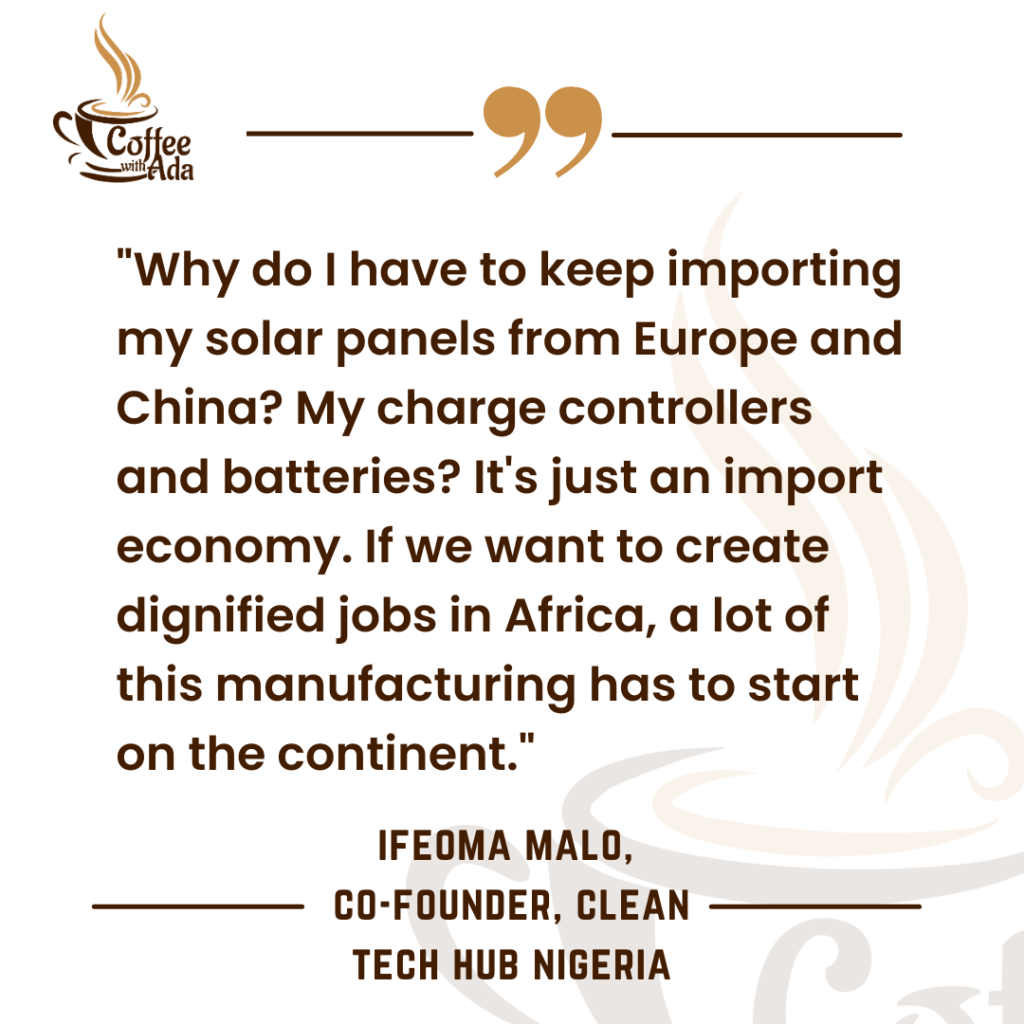
But she also pointed to a deeper problem that rarely gets discussed: Africa’s renewable energy sector still runs on imports. “Why do I have to keep importing my solar panels from Europe and China? My charge controllers and batteries? It’s just an import economy. If we want to create dignified jobs in Africa, a lot of this manufacturing has to start on the continent.”
The View From Monrovia
While the experts debated policy and investment, John-Charuk Siafa brought the perspective of someone who actually delivers services to citizens. He’s the Mayor of Monrovia — Liberia’s capital city.
“At a city level, the two things that are most important to the people we govern are access and affordability,” he said. The disconnect between policy and reality, he explained, is stark. “We have cable lines passing over our communities. But the host community, at times, is not electrified. How do we host such multi-billion investments when we don’t have access to the very product that we, as a community, are expected to protect?”
In Monrovia and across Liberia, urban electricity access hovers around ~30-35%. In rural areas, it’s closer to 3.5%. The national government controls energy infrastructure — not the cities. So mayors are held accountable for problems they can’t actually solve.
“If a community is not electrified, it’s dark,” he said. “We have security problems. Clinics and hospitals can’t operate after hours. The cost of electricity is passed on to businesses, then to citizens.” His conclusion was blunt: “It shouldn’t be either/or. Both access and affordability matter.”
The Leapfrog Myth
The conversation then turned to one of Africa’s most highlighted ideas: the leapfrog. The notion that the continent can skip fossil fuels entirely and go straight to clean energy — like mobile phones skipping landlines.
Stanley Opara wasn’t buying it. “Oil and gas will play a very real role, especially in places where we need to industrialise,” he said. “We cannot industrialise slowly. That’s the truth. So we have to ensure that it’s used sustainably by reducing emissions in our productions — the technologies are available today.”
He pointed to Nigeria, which flared nearly 200 billion cubic feet of gas last year. That gas could have powered 17 million homes. “That’s the tension,” he said. “We talk about emission reduction, but we’re also talking about economic imperative. Both matter.”
Ifeoma Malo agreed — with a caveat. She’s seen the renewable energy sector evolve rapidly. Solar panels are smarter. Batteries are smaller and more efficient. The technology is advancing faster than most people realise. But she acknowledged that leapfrogging works in some places, not all.
The Financing Problem
The panel didn’t shy away from the uncomfortable truths about international climate financing.
“We keep being told to build renewable energy plants,” Ifeoma Malo said. “But nobody wants to give us the money to actually build them. They want to give us technical assistance. They give us skills. But where’s the capital? We spend millions importing solar panels from China each year — money that could build transmission infrastructure instead.”
Stanley Opara echoed this. International investors talk a good game at conferences in Houston or Copenhagen. But when it comes to actual capital deployment in Africa, the money doesn’t flow the way it’s promised. “We need to go together,” he said. “All energy sources. The world needs to understand that Africa cannot industrialise on solar alone.”
What Sovereignty Actually Looks Like
One of the most animated parts of the conversation came when the panel tackled energy sovereignty — Africa’s ability to make its own decisions about its energy future.
John-Charuk Siafa was direct: “We need to be deliberate in balancing export ambition versus domestic access. It’s very important. That balance has to be in the contracts, not just the policies.”
Ifeoma Malo added that local content laws are only as good as their implementation. “Many countries have them. But it’s not about having the laws — it’s about enforcing them and giving local people the power to participate.”
The panel also discussed the Dangote refinery — a rare example of Africa building its own processing infrastructure rather than exporting raw materials. “That,” said Stanley Opara, “is how we change the narrative.”
The Question That Matters Most
The conversation at Harvard didn’t end with neat answers. That’s because there aren’t any. But it did surface the question that matters most: Can Africa chart its own energy path — on its own terms?
The panelists weren’t ideological. They weren’t pushing oil or renewables. They were pushing for practical solutions that work for real people in real communities. They were pushing for contracts that build local capacity, not just extract resources. They were pushing for financing that actually reaches the ground, not just conference rooms.
The answer, ultimately, isn’t either/or. It’s both. It’s building the infrastructure, the policies, and the local expertise to make energy work for everyone — while also keeping Africa’s future in African hands.
That’s the conversation happening now. And it’s one Africa can’t afford to wait any longer to have.
Key Takeaways
Download our Key Takeaways Summary.
Did this conversation resonate with you? Drop your thoughts in the comments, or email us at coffeewithada@gmail.com