By Ada Ezeokoli
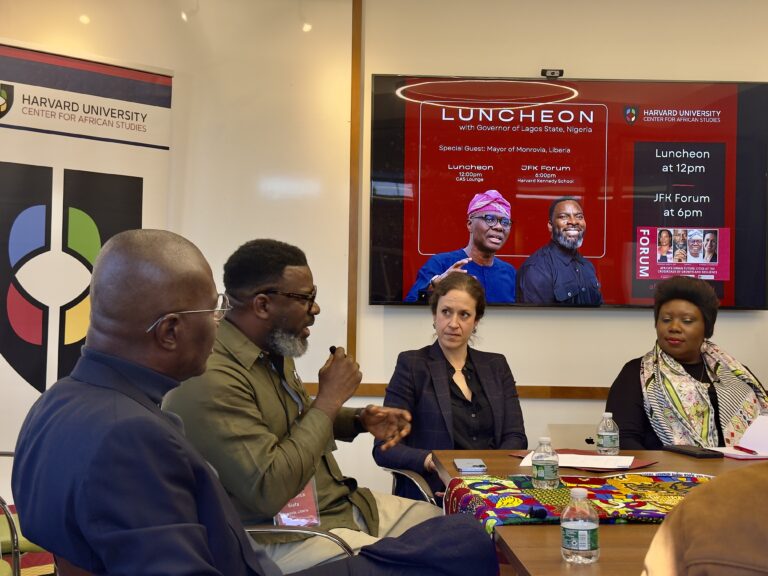
At a recent conversation at the Harvard University Center for African Studies, two African city leaders offered a thoughtful reflection on governance, scale, and the future of urban Africa:
- The Governor of Lagos, Nigeria — Africa’s largest megacity
- The Mayor of Monrovia, Liberia — Liberia’s historic coastal capital
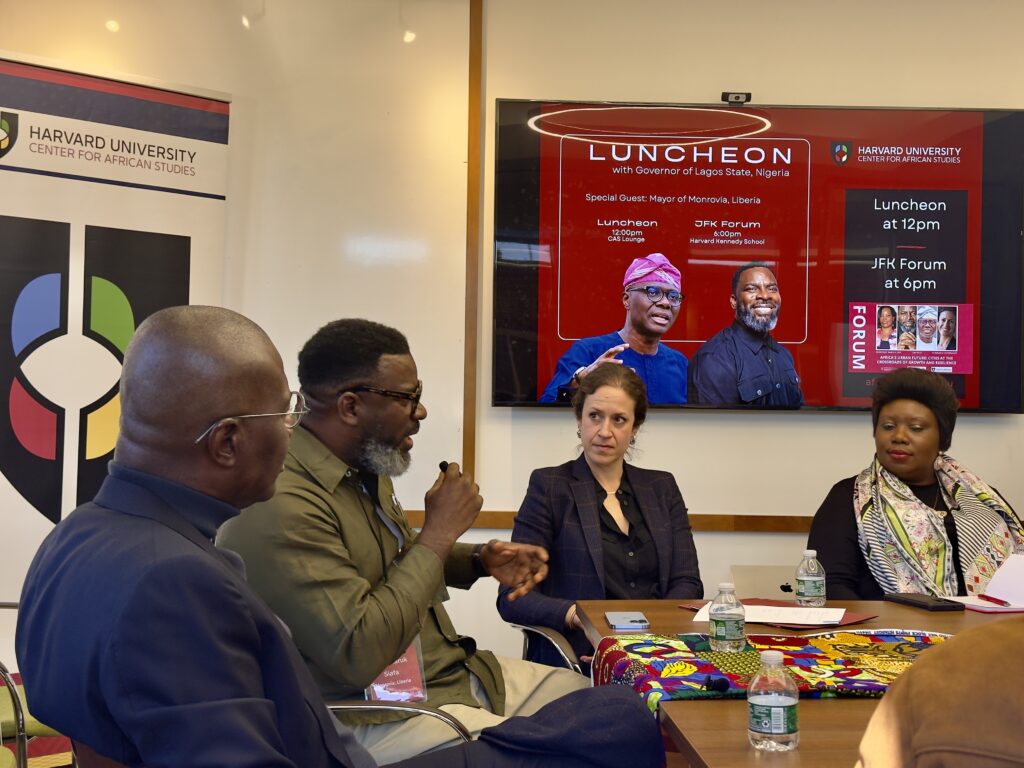
Both men share something uncommon in African politics: they built their careers in the private sector before stepping into public office. And both are grappling with a defining question of our time:
How do you build cities fast enough for Africa’s future — without leaving people behind?
The Private-to-Public Pipeline
A central theme of the conversation was the transition from corporate leadership into government service.
The Governor of Lagos spent nearly two decades in banking, retiring as a general manager before joining public service in 2003. He described leaving a corner office to become a “Special Adviser on Corporate Matters” in Lagos — at a time when public-private partnerships were still emerging in Nigeria.
“We all complained about governance. When the opportunity came to serve, I couldn’t say no,” he said.
He framed governance as execution at scale — not unlike managing a complex financial institution. The difference, he noted, is that public decisions shape how millions live, commute, learn, and access healthcare.
Similarly, the Mayor of Monrovia built a 20-year career in entrepreneurship, insurance, and business development before stepping into City Hall. His move was driven by a desire to “fix what is possible.”
“You move from private sector efficiency into public complexity — and you must adapt quickly,” he said.
Both leaders emphasized that the future of African governance depends on more professionals crossing this bridge.
Lagos: Governing at Megacity Scale
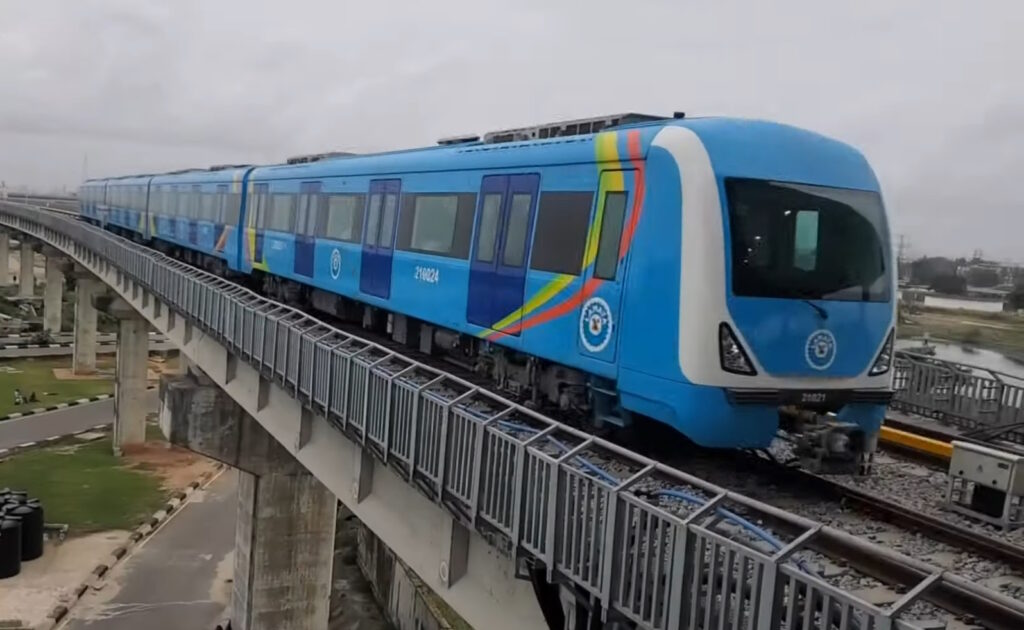
With a population exceeding 20 million and growing rapidly, Lagos operates at an extraordinary scale. The Governor framed his legacy around three pillars:
1. Infrastructure as Economic Engine
- Two operational rail lines (part of a six-line vision)
- Expanded ferry systems
- 5 million residents using the Cowry transport card
- New data centers and fiber backbone development
“If we say we are a megacity, our infrastructure must reflect it.”
The governor says the administration has quadrupled project scale over six years — building rail, expanding public transit, and investing heavily in transport alternatives to reduce congestion and improve safety.
2. Education at Massive Scale
One of the most striking figures shared:
- 35 new public schools in one complex
- Capacity for 22,000 students
- Emphasis on AI, technology, sports, and creativity
The governor noted that Lagos now operates Nigeria’s largest state university, with over 80,000 students, and has added two new universities — one focused on technology and another on education.
His goal: human capital development that matches demographic reality.
3. Technology, Data & AI Readiness
Lagos positions itself as Africa’s startup capital. The Governor acknowledged that for government to truly collaborate with innovators, it must first solve its own data gaps:
- Digitizing land records
- Building interoperable health records
- Expanding broadband infrastructure
- Developing hyper-scale data centers
“Data is the foundation. Without reliable data, you cannot scale AI or governance.”
For founders in the room, his message was clear:
Don’t innovate in isolation. Align with public priorities.
The Hard Questions: Inclusivity & Urban Displacement
Students pushed back — raising concerns about demolitions, informal settlements, and bans on motorcycle taxis.
The Governor addressed Makoko and other waterfront communities, acknowledging communication failures while defending safety-based enforcement decisions. He pointed to relocation efforts where government built over 600 new homes for displaced residents in another community — though he noted that “good news is often no news.”
His argument was rooted in urban order:
- Informal transport contributes to high accident rates
- Settlements under high-tension power lines pose catastrophic risk
- A megacity must balance compassion with regulation
Yet he conceded:
“We must communicate better. Inclusivity must not just be intention — it must be understood.”
Monrovia: Planning a City That Was Never Built for 1 Million
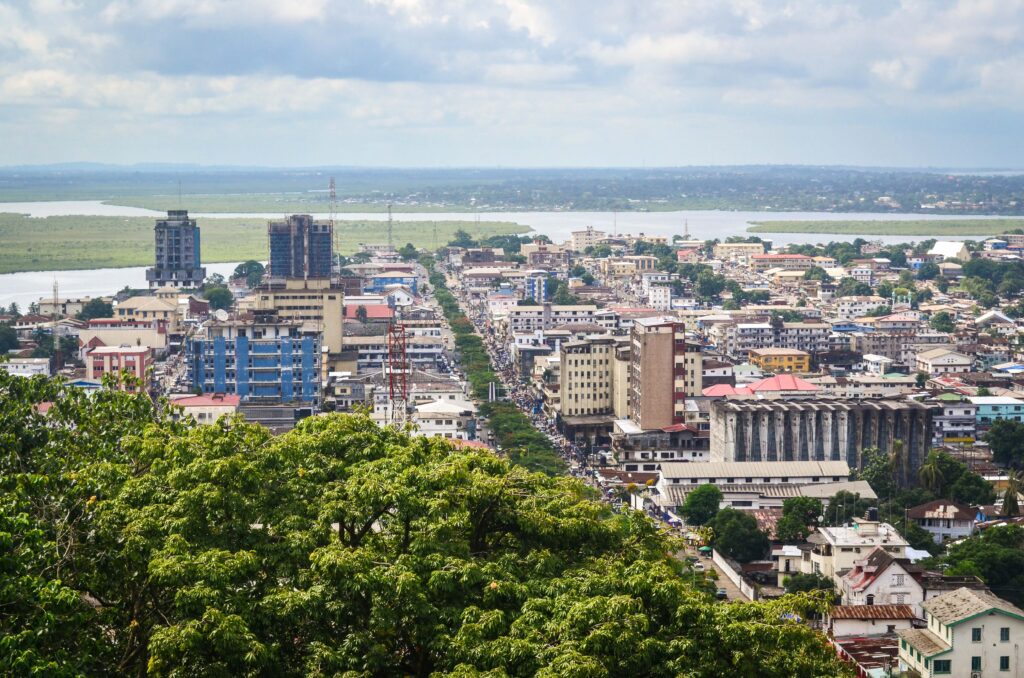
If Lagos is scale, Monrovia is structural fragility.
Originally designed for roughly 300,000 residents, Monrovia now hosts over 1 million — shaped by post-war rural-to-urban migration rather than industrial expansion.
The Mayor outlined a different but equally urgent set of challenges:
1. Waste Management & Informality
Before taking office, he mobilized 10,000 volunteers to remove millions of kilograms of waste from Liberian cities. He mentioned that he came into office a few months before a $25 million World Bank project that heavily supported waste management ended. As a result all subsidies were gone, leaving the city to operate largely on its own revenue and the support of the national government.
Now in office, he is:
- Structuring waste management PPPs
- Negotiating with international investors
- Balancing large firms with local informal waste collectors
“Urbanization without destabilization.”
Large investors cannot access slum communities. Informal waste workers can. Reforms must integrate — not eliminate — local actors.
2. Climate Vulnerability
Monrovia faces:
- Coastal erosion
- Sand mining
- Slum communities on waterways
- Tourism potential under threat
The city is conducting its first climate risk mapping and infrastructure audit to inform a 25-year long-term plan.
For the first time, Monrovia is developing:
- A land use plan
- A 10-year master plan
- Zoning reforms
“Planning is everything. Without legal tools, you cannot develop a city,” the Mayor said.
3. Strengthening the Foundations of City Governance
For the leadership of Monrovia, the challenge is not only about infrastructure — it is about institutional capacity.
When the current administration took office, the city inherited major structural constraints: weak administrative systems and limited municipal revenue.
Addressing these challenges required more than new policies. It required rebuilding the internal machinery of city government.
The mayor described a series of reforms aimed at strengthening Monrovia’s ability to function as a modern municipal authority. These include restructuring departments within City Hall, improving financial management systems, and rebuilding credibility with international partners and development institutions.
At the same time, the city is investing in human capital — from training municipal staff to strengthening early childhood education programs. The goal is not only to manage the city’s present challenges, but to build a stronger administrative foundation for the future.
But the mayor was candid about the scale of the task.
Urban transformation, he noted, cannot be achieved by government alone. It requires collaboration across universities, researchers, innovators, and international partners.
“We do not have all the answers. We need co-created solutions.”
For Monrovia, the path forward lies in building institutions that can plan, partner, and implement — ensuring that the city’s rapid growth is matched by equally strong governance systems.
Shared Challenges: Demography is Destiny
Both cities face similar demographic realities:
- 60–70% of the population under 35
- Rapid rural-to-urban migration
- Infrastructure growth lagging behind population growth
The Governor of Lagos was blunt:
“The system is not growing as fast as the people.”
The Mayor of Monrovia echoed the concern — noting that urban migration without economic expansion creates pressure, informality, and instability.
Tourism, Diaspora & Cultural Economy
Students also asked about the tourism surge in Lagos — particularly December’s diaspora return.
The Governor sees culture and creativity as economic strategy:
- Film
- Music
- Entertainment
- Creative entrepreneurship
Both leaders stressed that tourism must support local businesses — not just hotels and airlines.
AI & The Future of African Cities
When asked about AI education, the message from Lagos was pragmatic:
- Build digital infrastructure
- Secure reliable data
- Partner with universities
- Enable private-sector collaboration
Monrovia emphasized capacity building and research collaboration across African cities.
The broader takeaway:
AI without infrastructure is theory.
Infrastructure without human capital is waste.
Coffee with Ada Takeaways
This conversation revealed five powerful insights:
☕ 1. Africa’s urban future will determine its global future: By 2100, one in three people on earth will be African — most in cities.
☕ 2. Private-sector discipline is entering public service: A growing pipeline of technocrats and entrepreneurs are choosing governance.
☕ 3. Scale changes everything: Lagos builds for millions. Monrovia builds foundational systems. Both matter.
☕ 4. Communication is governance: Good policy without good storytelling becomes public mistrust.
☕ 5. The next solutions must be co-created: Governments are asking universities, technologists, and diaspora innovators to engage — not critique from afar.
As the moderator, Prof. Zoe Marks, Faculty Director of the Center for African Studies, concluded:
“Africa is the only growing labor market and consumer market. The cities you build today will shape humanity’s tomorrow.”
For students in the room — the invitation was clear:
The future of African cities is not abstract.
It is a design problem.
A governance challenge.
A human capital investment.
And it is already underway. ☕