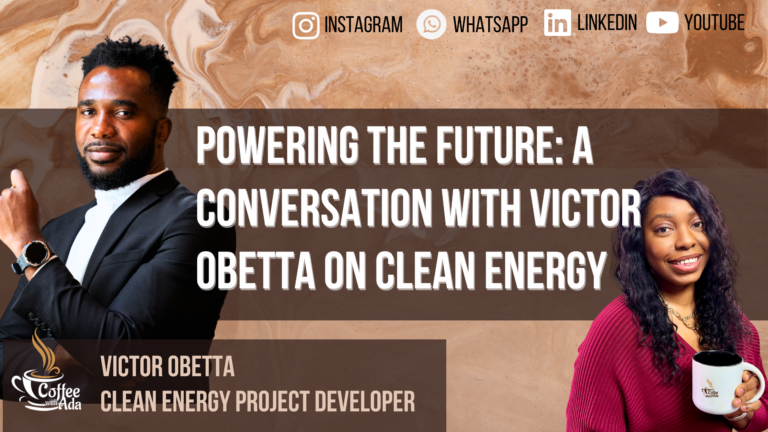
The clean-energy project development professional discusses infrastructure execution, municipal systems, distributed energy, and the future of sustainable development across Africa.
By Ada Ezeokoli
For millions across Africa, unreliable electricity is not an abstract policy issue — it is a daily reality that shapes education, healthcare, business, and opportunity. For Victor Obetta, that reality was personal long before it became professional.
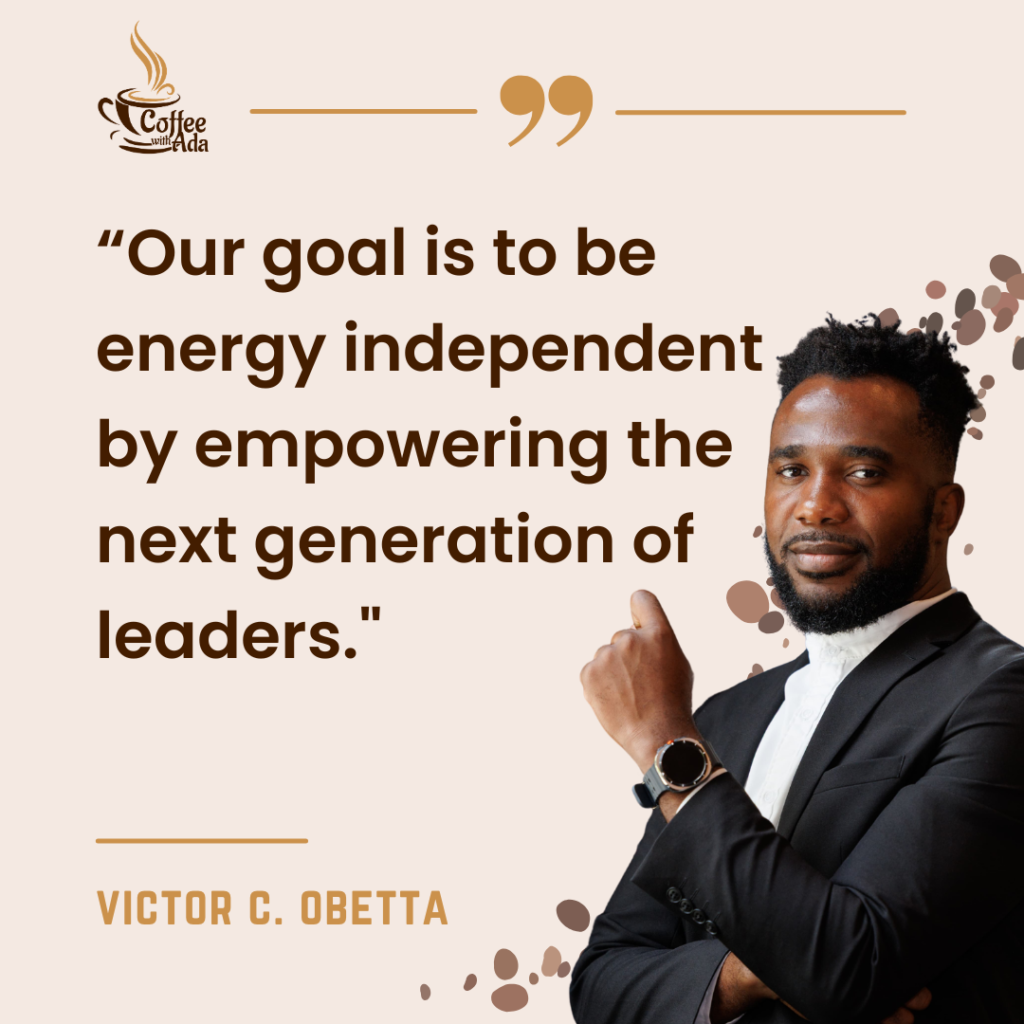
Growing up in Nigeria surrounded by power outages and the constant hum of generators, Victor experienced firsthand how energy access can define the rhythm of everyday life. Today, working in the United States at the intersection of municipal energy systems, electrification, decarbonization, and infrastructure development, he is part of a new generation of African professionals helping shape the future of clean energy implementation.
As a Project Development Manager, Victor has worked on clean-energy initiatives involving solar systems, battery storage, EV infrastructure, and municipal decarbonization projects across multiple U.S. states. His work combines analytics, project development, stakeholder coordination, and public-sector collaboration — experience that increasingly informs how he thinks about Africa’s energy future.
In this Q&A with Coffee With Ada, Victor reflects on energy poverty, infrastructure execution, lessons from American municipalities, the role of the African diaspora, and why he believes Africa has a historic opportunity to build a more distributed, equitable, and sustainable energy future.
An edited excerpt of the Q&A follows.
1. What first sparked your interest in energy and infrastructure work?
Honestly, it was not a straight line. I grew up in Nigeria where power outages were a normal part of life. Load shedding. Generators running through the night. You plan your day around electricity, not because you want to, but because you have to. That experience planted something in me early, even if I did not name it at the time.
When I came to the United States, I played soccer, earned my degrees, and eventually landed in business analytics. I was doing good work. But I kept asking myself, “Is this the work that matters most?” The answer kept pointing me toward energy.
The truth is, when I met the team at Transform Power Systems during a critical career pivot, everything clicked. I saw that clean energy was not just a technical field. It was a justice issue. It was an opportunity issue. It was the kind of problem that needed people who could think analytically and engage communities at the same time.
That combination, analytics plus community plus energy, is where I belong. And once I found it, I never looked back.
2. How has your background in analytics and stakeholder engagement shaped your approach to clean-energy challenges?
Most clean energy projects do not fail because of bad technology. They fail because someone could not build the financial case, could not navigate the grant process, or could not get the community on board. Engineering alone does not solve that.
My background in business analytics gives me the ability to look at a project and build the data story around it. Load profiles. Financial models. Emissions calculations. Funding scenarios. That is the language funders speak, and I am fluent in it.
But I also understand people. Through years of stakeholder engagement with municipal officials, school administrators, and community members, I have learned that numbers alone do not win trust. You need to show up. You need to listen. You need to translate complex energy concepts into plain language that a city council member can take home and explain to their constituents.
The truth is, I sit at the intersection of data and people. And in clean energy project development, that intersection is exactly where the work gets done.
3. What lessons from business development, analytics, and municipal energy projects now shape how you think about Africa’s energy future?
Every industry I have worked in has taught me something about execution. At Bain and Company, I learned the value of systems and precision. At Nexthink, I learned how to communicate value quickly and build pipelines. At Transform Power Systems, I learned that clean energy development is about translating policy into physical infrastructure, one community at a time.
The lesson I carry most strongly into thinking about Africa is this: capital and technology are rarely the real bottleneck. The real bottleneck is execution capacity. The ability to take a funded opportunity and turn it into a built project. That is what is missing at scale across most of the continent.
I have managed a $6.2 million clean energy project pipeline in the United States, submitted over 80 grant and proposal documents, and worked across 18 states. That experience taught me what it takes to close the gap between a policy commitment and an operational solar system or a charging station that actually works.
Africa needs practitioners who can do that work at scale. And I believe the continent’s own diaspora — people who carry both technical training and cultural context — is the asset that makes it possible.
4. What is the biggest energy opportunity in Africa right now?
The biggest opportunity is distributed energy. Solar plus storage at the community level. Mini-grids. Off-grid solutions designed for the way African communities actually function, not the way Western infrastructure models assume they function.
Africa has 60 percent of the world’s best solar resources. Sixty percent. That is an extraordinary endowment. And yet only about one percent of global installed solar capacity is on the African continent.
That gap is not a technology problem. The technology exists and it is more affordable than it has ever been. It is an execution and financing problem.
The opportunity right now is to build the project development infrastructure that can convert that solar potential into operating systems. To train and deploy practitioners who understand both the technical and the financial side of clean energy deployment. To build the data and analytical foundations that make projects bankable and communities investable.
Every community with reliable electricity has a foundation for economic development, better health outcomes, and better education. That is not theoretical. That is documented.
5. Why does Africa still struggle with energy reliability despite abundant resources?
The honest answer is that this is an execution gap more than anything else. The resources are there. The investment is arriving. But projects keep stalling.
They stall in regulatory approvals. They stall in community engagement. They stall because the gap between investment commitment and project completion has not been adequately addressed.
I see this pattern in the United States too, in underserved communities with limited administrative capacity. The challenge is not unique to Africa, but it is more severe there because the institutional infrastructure at the local government level is less developed.
Add to that policy instability, currency risks, and fragmented financing systems, and you have a structure that makes execution difficult.
The solution is not to lower standards. It is to build practitioner capacity, analytical tools, and financing systems that allow projects to move from commitment to commissioning. That is the work.
6. Which clean-energy technologies could have the most immediate impact in African communities?
Solar plus storage. Full stop.
EV charging infrastructure depends on an existing reliable grid. Decarbonization programs require baseline emissions data and policy frameworks that are still developing across much of the continent. But solar with battery storage is modular, scalable, and does not depend on grid connectivity.
It can work in a village. It can work in a school. It can work in a health clinic.
And health clinics are where I would start. A clinic with reliable electricity can maintain cold chains for vaccines, power diagnostic equipment, and provide safe lighting for nighttime deliveries.
The same logic applies to schools. A school with solar and storage can run digital learning tools, extend study hours, and connect students to broader educational systems.
Solar plus storage is not the only answer, but it is the most immediate and scalable answer for the communities that need it most.
7. What can African cities learn from U.S. municipalities about planning sustainable energy systems?
The most important lesson is to plan with data.
In my work with American municipalities, the projects that succeed are the ones where someone has done the analytical homework upfront — load profiles, utility assessments, emissions baselines, and long-term planning models.
African cities that are growing rapidly have the opportunity to build that data infrastructure now, before the next round of construction is locked in. Retrofitting a city is far more difficult and expensive than planning it correctly from the beginning.
The second lesson is integrated planning. The municipalities doing the best work are the ones connecting energy planning to transportation, housing, and economic development strategy.
Energy is not a siloed infrastructure issue. It is a platform.
The third lesson is equity. The communities with the fewest resources should not be the last served. Resilient cities are cities where every neighborhood has reliable energy access.
8. How important is long-term policy consistency for attracting energy investment?
It is critical.
Investors price risk into every decision they make. Policy uncertainty raises the cost of capital, delays projects, and can cause investment to disappear entirely.
When policies change unpredictably after elections, investors lose confidence. And once confidence is lost, attracting the next round of capital becomes significantly harder.
The countries making the strongest progress are the ones creating rules-based procurement systems and stable regulatory frameworks that outlast political cycles.
The solution is institutional architecture — independent regulatory systems, transparent procurement structures, and long-term policy frameworks that make energy investment predictable.
You cannot build large-scale infrastructure without trust in the system supporting it.
9. What systems or practices from the U.S. could African governments adapt successfully?
Three things stand out immediately.
First, structured grant programs with transparent criteria. Communities need predictable pathways to funding and clearly documented application systems.
Second, centralized procurement systems. A unified platform dramatically reduces information gaps and increases visibility into opportunities.
Third, technical assistance programs. One of the most effective things the U.S. does is provide communities with the technical support needed to execute projects successfully — feasibility studies, project advisors, procurement guidance, and implementation support.
Funding alone is not enough. Communities also need the technical capacity to use that funding effectively.
10. Why is collaboration between government, private companies, and communities essential in energy development?
Because no single actor can do this alone.
Government has regulatory authority and public responsibility. Private companies bring technical expertise and operational capacity. Communities bring local knowledge and legitimacy.
When those three are aligned, projects move. When they are disconnected, projects stall.
The projects I have seen succeed most effectively are the ones where the municipality understood its needs, contractors understood the community context, and everyone involved could clearly articulate the public benefit.
Clean energy development cannot be purely top-down or purely bottom-up. The collaboration between those levels is what turns policy into infrastructure.
11. How important is networking and ecosystem-building in advancing development projects?
It is everything.
People work with people they trust. And trust is built through consistent presence, demonstrated competence, and genuine engagement over time.
I have represented Transform Power Systems at dozens of industry events across Massachusetts and beyond. Every one of those events was an investment — not just in relationships, but in understanding the ecosystem, learning what agencies are prioritizing, and building the kind of trust that turns conversations into opportunities.
The most important projects often begin long before a formal proposal is submitted. They begin with relationships.
For African development work especially, ecosystem-building matters enormously. The practitioners who will have the greatest impact are the ones deeply connected to governments, communities, funding ecosystems, and implementation networks.
You cannot build that from a distance. You have to show up consistently.
12. What mistakes should African countries avoid as they expand energy infrastructure?
First, do not skip the analytics foundation. Infrastructure decisions without data lead to project failures and wasted capital.
Second, do not build dependency on a single external partner without developing local capacity to operate and maintain the systems being built.
Third, do not exclude communities from planning processes. Infrastructure imposed on communities without engagement rarely succeeds long term.
And finally, do not let perfection delay progress.
Start with pilot projects. Start with data collection. Start with one community that can become a model for the next ten.
The urgency is real, and the window for scalable clean-energy deployment is open right now.
13. What skills do young Africans need to compete in the future clean-energy economy?
Three skills above all others: data literacy, project management, and communication.
The clean-energy economy runs on data — financial models, load analysis, emissions tracking, and performance metrics.
Project management is equally critical because clean energy development is fundamentally about execution. Moving projects from concept to completion requires coordination, discipline, and systems thinking.
And communication is underrated. The ability to explain technical concepts clearly to investors, communities, or government officials is a genuine competitive advantage.
Technical expertise matters. But the people who can combine technical understanding with communication and execution skills will lead this transition.
14. What inspired the Obetta Foundation, and how does it connect to your broader vision for Africa?
My late father inspired it.
He believed deeply that investing in a young person could change the trajectory of an entire family and community. He invested in my education when it was not easy to do so, and I understand those sacrifices more fully now as an adult.
The Obetta Foundation is my way of extending that belief.
The foundation supports educational and athletic opportunities for underserved youth because I know what it feels like to have potential but limited access.
To me, energy access and human capital development are connected. A child who can study after dark has a better chance at education. A student with strong educational opportunities has a better chance at contributing to community development.
Ubuntu grounds all of it: I am because we are.
15. What role can the African diaspora play in accelerating innovation and infrastructure development?
The diaspora carries something incredibly valuable — technical expertise developed in advanced economies combined with cultural understanding and lived connection to African communities.
That combination matters.
The most impactful contribution the diaspora can make right now is not simply investment. It is knowledge transfer, mentorship, institutional collaboration, and implementation expertise.
The professionals who understand sophisticated procurement systems, project financing, and infrastructure development abroad — and can adapt those lessons thoughtfully to African realities — are uniquely positioned to help accelerate development on the continent.
That is part of why I write and participate in conversations like this. Knowledge should not stay isolated in one geography. It should circulate.
16. What gives you the most hope about Africa’s future?
The young people.
Africa is the youngest continent in the world. That is not a burden. It is an extraordinary advantage.
I see hope in the entrepreneurs building clean-energy companies, healthcare systems, fintech platforms, and agricultural technologies designed specifically for African realities.
I also see hope in the diaspora’s growing commitment to engagement — people building expertise abroad and finding ways to contribute back home.
The future I believe in is one where Africa becomes a global leader in distributed clean energy and sustainable infrastructure development.
And I believe that future is achievable.
17. What has living and working in America taught you about leadership and execution?
America taught me that execution is a discipline.
The most effective leaders are not always the loudest or even the most brilliant. They are the people who follow through consistently. They close loops. They build systems. They do what they said they were going to do.
I also learned that leadership in diverse environments requires cultural intelligence — the ability to work across different communication styles, backgrounds, and perspectives while remaining grounded in your own values.
And perhaps most importantly, I learned that the work itself is the message.
The projects you complete, the systems you improve, the people you impact — those things ultimately speak louder than titles or promises.
18. If you could give African policymakers one message about energy and development, what would it be?
Stop treating energy as a standalone infrastructure problem and start treating it as the platform that everything else depends on.
Healthcare depends on reliable electricity. Education depends on reliable electricity. Economic development depends on reliable electricity.
Energy is not one sector among many. It is foundational infrastructure.
I would also say this: invest in execution capacity as seriously as you invest in policy.
The gap between a good policy announcement and a functioning infrastructure project is filled with technical work, financial structuring, stakeholder coordination, and project management.
That work does not happen automatically. You have to build the human and institutional systems capable of delivering it.
The opportunity is here right now. But windows close. The decisions made over the next decade will shape Africa’s development trajectory for generations.
19. What does success look like for you beyond career achievements?
Success looks like legacy.
It looks like being able to point to a community with reliable electricity and knowing I played a role in making that possible.
It looks like helping open doors for young people the same way doors were opened for me.
The Obetta Foundation, mentorship, leadership work, and knowledge-sharing are all part of that.
Ubuntu shapes how I think about success. My achievements are not mine alone. They are connected to every person who invested in me and every community that shaped me.
If the work I do contributes to a more energy-secure, equitable, and hopeful future — both in Africa and in underserved communities elsewhere — then I will have lived a meaningful life.
20. What is your vision for an energy-secure and economically empowered Africa?
My vision is an Africa where no child studies by candlelight because there is no other option.
Where no clinic loses vaccines because the power failed.
Where distributed clean-energy systems power schools, health clinics, businesses, and communities that centralized grids have never fully reached.
I believe Africa can become a global model for how to build a clean-energy economy from the ground up.
In that future, African entrepreneurs, engineers, analysts, and project developers are leading the transition. The diaspora is contributing knowledge, investment, and institutional expertise. And the next generation grows up with opportunities previous generations did not have.
That vision is ambitious. But it is achievable.
And I intend to spend my life helping make it real.